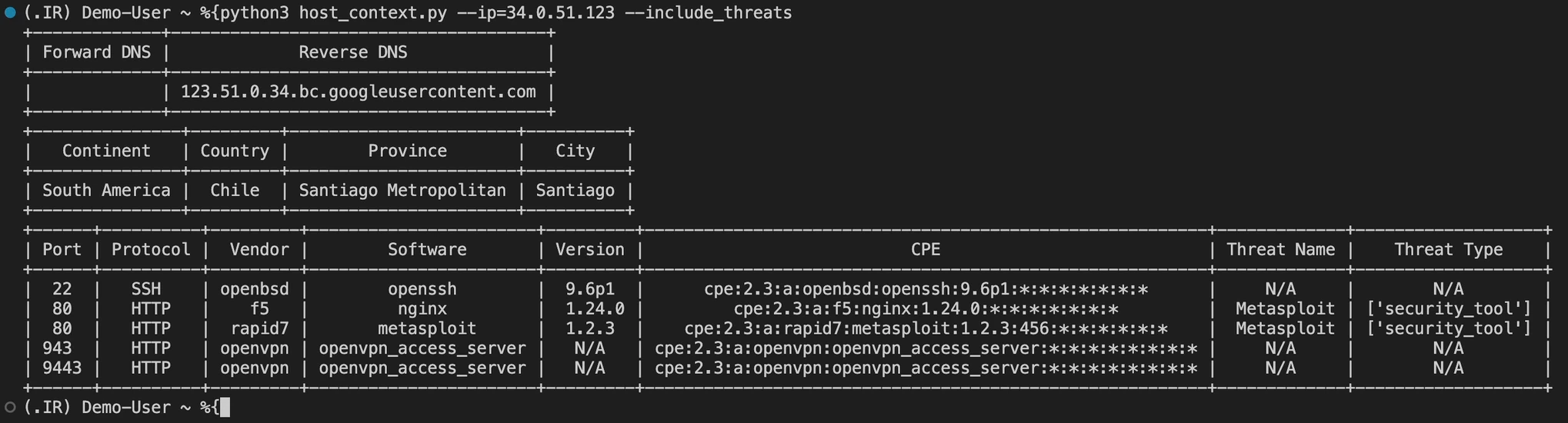


Wanted to share this python script that one of my colleagues showed me. You can use it to quickly return useful information about a host including location, DNS, ports and protocols, and software information. If you have access to threat data, you can use the --include_threats tag to highlight that info in the readout as well.
You’ll need to install the Platform SDK and prettytable to get it running.
import argparse
from censys_platform import SDK, RetryConfig
from censys_platform.utils import BackoffStrategy
from prettytable import PrettyTable

# Parse arguments
parser = argparse.ArgumentParser(description="Retrieve data for a given IP address.")
parser.add_argument("--ip", required=False, help="IP address to query")
parser.add_argument("--include_threats", action="store_true", help="Include threats in the output")
args = parser.parse_args()

ip_address = args.ip if args.ip is not None else "34.0.51.123"
include_threats = args.include_threats

# API Key and Org ID for Platform
organization_id = "ORG_ID_HERE_OR_LOAD_FROM_ENV"
platform_api_key = "censys_API_KEY_HERE_OR_LOAD_FROM_ENV"

with SDK(
        organization_id=organization_id,
        personal_access_token=platform_api_key,
        retry_config=RetryConfig("backoff",
                                 BackoffStrategy(100, 10000, 1.5, 30000),
                                 True)
) as sdk:
    res = sdk.global_data.get_host(host_id=ip_address)
    fwd_dns_records = []
    if res.result.result.resource.dns.forward_dns is not None:
        for record in res.result.result.resource.dns.forward_dns:
            fwd_dns_records.append(record)
    rev_dns_records = []
    if res.result.result.resource.dns.reverse_dns is not None:
        for record in res.result.result.resource.dns.reverse_dns.names:
            rev_dns_records.append(record)
    if res.result.result.resource.location is not None:
        location = res.result.result.resource.location
        continent = location.continent
        country_code = location.country_code
        country = location.country
        province = location.province
        city = location.city
    services = []
    for service in res.result.result.resource.services:
        new_service = {
            "port": service.port,
            "protocol": service.protocol,
            "software": [],
            "threats": [],
        }
        for software in service.software:
            new_software = {}
            if software.vendor is not None:
                new_software["vendor"] = software.vendor
            if software.product is not None:
                new_software["software"] = software.product
            if software.version is not None:
                new_software["version"] = software.version
            if software.cpe is not None:
                new_software["cpe"] = software.cpe
            new_service["software"].append(new_software)

        if include_threats:
            for threat in service.threats:
                new_threat = {}
                if threat.name is not None:
                    new_threat["name"] = threat.name
                if threat.type is not None:
                    new_threat["type"] = threat.type
                new_service["threats"].append(new_threat)
        services.append(new_service)

# Create a combined visual table for forward and reverse DNS records
dns_table = PrettyTable()
dns_table.field_names = ["Forward DNS", "Reverse DNS"]

# Determine the maximum length between the two lists for iteration
max_len = max(len(fwd_dns_records), len(rev_dns_records))

# Add rows to the table, pairing forward and reverse DNS records
for i in range(max_len):
    fwd_record = fwd_dns_records[i] if i < len(fwd_dns_records) else ""
    rev_record = rev_dns_records[i] if i < len(rev_dns_records) else ""
    dns_table.add_row([fwd_record, rev_record])

# Create a visual table for location information
location_table = PrettyTable()
location_table.field_names = ["Continent", "Country", "Province", "City"]
location_table.add_row([continent, country, province, city])

# Create a visual table for services
services_table = PrettyTable()
if not include_threats:
    services_table.field_names = ["Port", "Protocol", "Vendor", "Software", "Version", "CPE"]
else:
    services_table.field_names = ["Port", "Protocol", "Vendor", "Software", "Version", "CPE", "Threat Name", "Threat Type"]

# Create a visual table for services
services_table = PrettyTable()
if not include_threats:
    services_table.field_names = ["Port", "Protocol", "Vendor", "Software", "Version", "CPE"]
else:
    services_table.field_names = ["Port", "Protocol", "Vendor", "Software", "Version", "CPE", "Threat Name",
                                  "Threat Type"]

for service in services:
    for software in service["software"]:
        # Only add rows with at least one valid piece of software data
        if (
                software.get("vendor", "N/A") != "N/A"
                or software.get("software", "N/A") != "N/A"
                or software.get("version", "N/A") != "N/A"
                or software.get("cpe", "N/A") != "N/A"
        ):
            if include_threats:
                # Check if there are any threats
                if service["threats"]:
                    for threat in service["threats"]:
                        services_table.add_row([
                            service["port"],
                            service["protocol"],
                            software.get("vendor", "N/A"),
                            software.get("software", "N/A"),
                            software.get("version", "N/A"),
                            software.get("cpe", "N/A"),
                            threat.get("name", "N/A"),
                            threat.get("type", "N/A"),
                        ])
                else:
                    # If no threats, add a single row with N/A for threat fields
                    services_table.add_row([
                        service["port"],
                        service["protocol"],
                        software.get("vendor", "N/A"),
                        software.get("software", "N/A"),
                        software.get("version", "N/A"),
                        software.get("cpe", "N/A"),
                        "N/A",
                        "N/A",
                    ])
            else:
                services_table.add_row([
                    service["port"],
                    service["protocol"],
                    software.get("vendor", "N/A"),
                    software.get("software", "N/A"),
                    software.get("version", "N/A"),
                    software.get("cpe", "N/A"),
                ])


if 'dns_table' in locals():
    print(dns_table)
if 'location_table' in locals():
    print(location_table)
if 'services_table' in locals():
    print(services_table)
After you add your API key and org info, you can run a command like:
python host_context.py --ip=[IP address] --include_threats
To retrieve info about the IP, including threat data. The output will be provided in an easy-to-use table.